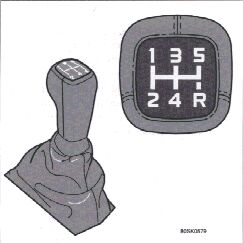
Shift positions
Depress the clutch pedal completely when changing gears.
Remove your foot from the clutch pedal while driving.
Overdrive (5th gear) should be used as often as possible to help improve fuel economy. This gear can be engaged at speeds above approx. 50 mph (80 km/h).
CAUTION: Follow the shift pattern indicated on the gear shift knob when shifting up (e.g., do not shift directly from 2nd to 5th gear) to help avoid excessive wear on the transmission. |
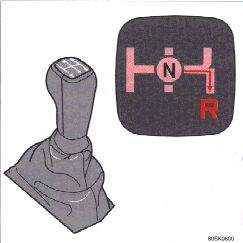
Engaging reverse gear
The gear lever must first be moved to neutral in order to engage reverse gear.
CAUTION: Be careful that you do not inadvertently engage reverse while moving forward. |
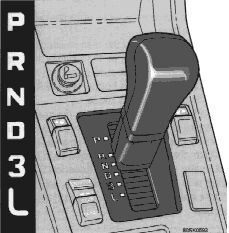
P (Park)
Use this position when starting the engine or parking the car.
Never use P while car is in motion.
The parking brake should also be used when parking on grades.
The gear selector is mechanically locked in the P position (Shift lock). To release the selector, start the engine and depress the brake pedal. If it is necessary to manually release the gear selector, see page 6:18 for instructions.
CAUTION: * Always observe posted speed limits. |
WARNING! Never leave the car when the engine is running. If, by mistake, the gear selector is moved from P the car may start moving. |
R (Reverse)
Never engage R while is moving forward.
N (Neutral)
Neutral = no gear is engaged. Use the parking brake. The engine can be started with the gear selector in this position.
D (Drive)
D is the normal driving position and should be used as often as possible to help improve fuel economy. When modes E or S are selected, upshift and downshift of the forward gears occur automatically and are governed by accelerator pedal position and vehicle speed.
3 (Intermediate position)
Automatically shifts up and down between 1st, 2nd, and 3rd gears when in driving modes E or S. There is no upshift from 3rd gear. Position 3 can be used for driving in hilly terrain, for towing trailers or for increased engine braking power.
L (low position)
No upshift can occur when L is engaged. Select position L for driving in first and second gears. Use this position to select low gear with no upshift, e.g. when ascending and descending steep grades. The transmission will noticeably shift down from second to first if road speed drops to below 40 km/h (25 mph) when driving in E mode and below 10 km/h (6 mph in S mode.
Kick-down
Automatic shift to a lower gear (kick-down) is achieved by depressing the accelerator pedal fully and briskly. An upshift will be achieved when approaching the top speed for a particular gear or by releasing the accelerator pedal slightly. Kick-down can be used for maximum acceleration or when passing at highway speeds.
"Lock-up"
The transmission has a "lock-up" function which reduces engine speed and saves fuel. "Lock-up" can sometimes be felt as an additional gear change.
pg. 4:8 Automatic transmission |
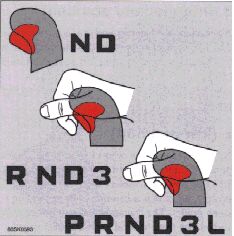
Shift gate positions
The gear selector can be moved freely between N and D. Selections of other positions are obtained by depressing the selector knob prior to moving the selector.
Slightly depressing the selector knob allows selection of positions R, N, D, 3 and L. Fully depressing the selector knob allows selection of positions P. This is also necessary when initially bringing the selector out of position P. Fully depressing the selector knob thus permits shifting freely between all positions.
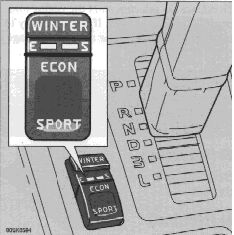
Mode selector
The push-buttons to the left of the gear lever are for selection of modes E, S and W. The desired mode can be selected at any time, including while the car is moving.
 Winter/Wet mode
Enhanced Vehicle Traction
This mode may be selected for starting/moving off on slippery roads.
In this mode:
* In position D, the gearbox starts in 3rd gear and changes up to 4th gear.
* In position 3, 2nd gear is locked and there is no change up to 3rd gear.
In position L, 1st gear is locked.
* These positions always offer the kick-down function.
The indicator lamp in the instrument panel
 lights up when this mode is selected (the lamp will also light up if the gear selector is in position 3 or L.). Press button WINTER in order to disengage this mode.
When mode is disengaged, the gearbox automatically reverts to the previously selected S or E mode. If the indicator lamp
begins to flash, this is an indication of a fault in the automatic gearbox. The Malfunction Indicator lamp will also light up if a fault is detected. Please contact your Volvo retailer if this occurs.
CAUTION: Driveability and fuel economy will be adversely affected by prolonged driving in mode W . Volvo recommends using this mode only when starting in extremely slippery conditions. |
 Economy Mode
This mode is used for normal driving. The gearbox changes gears at a lower engine speed to achieve the lowest possible fuel consumption.
 Sport Mode
This mode is adapted to "sporty" driving characteristics. The transmission upshifts at higher engine speeds and less accelerator pedal pressure is required to initiate a downshift.
Special Tips - automatic transmission
Cooling system
The risk for engine overheating is greatest, especially in hot weather, when:
WARNING! Do not remove the coolant expansion tank cap. |
See "Coolant" to check and top-up the coolant level if necessary.
CAUTION:
Drive slowly and carefully if going through standing water (i.e. flooded roadways, etc.). Damage to engine could result if excess water is ingested through the air intake system.
|
WARNING!
Do not drive with trunk lid or tailgate open!
|
Electrical system
When replacing the battery or when carrying out work involving the electrical system, the following should be observed:
pg. 4:11 Points to remember |
Weight distribution affects handling
At the specified curb weight your car has a tendency to understeer, which means that the steering wheel has to be turned more than might seem appropriate for the curvature of a bend. This ensures good stability and reduces the risk of rear wheel skid. Remember that these properties can alter with the vehicle load. The heavier the load in the trunk (max. 220 lbs, 100 kg), the less the tendency to understeer.
Handling, roadholding
Vehicle load, tire design, and inflation pressure, all affect vehicle handling. Therefore, check that the tires are inflated to the recommended pressure according to the vehicle load. See "Tire pressure" section.
Loads should be distributed so that capacity weight or maximum permissible axle loads are not exceeded.
WARNING! It is recommended that tire of the same make and dimensions be used on all four wheels (including the use of snow tires). Do not use bias ply tires as this will adversely alter vehicle handling characteristics. |
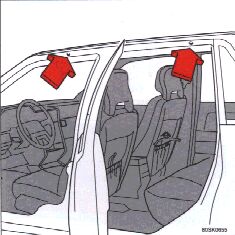
Roof racks
Roof racks are available as Volvo accessories. Observe the following points when is use:
WARNING! An extra mat on the driver's floor can cause the accelerator pedal to catch. Check that the movement of the accelerator pedal is not impeded. Not more than one protective floor covering may be used at one time. |

