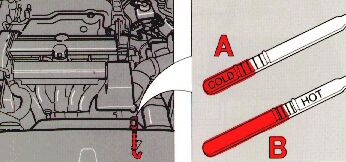
Check the oil level as follows:
Park the car on a level surface
with the engine idling
. Slowly move the gear selector lever through all the shift positions and then to position P. Wait 3 minutes before checking the oil level.
As the illustration shows, the dipstick has a
COLD
and a
HOT
side. The oil level should between the MIN and MAX marks. Wipe the dipstick with a clean cloth.
WARNING! The oil may be very hot. |
Do not use rags that could leave lint on the dipstick. The transmission is topped up via the dipstick tube. The space between the MIN and MAX marks on the dipstick corresponds to 0.5 US qt. (0.5 liter). Do not fill the transmission with too much oil, since this can result in oil being ejected from the transmission. Too little oil, on the other hand, can negatively affect transmission operation, particularly in very cold weather.
A
Cold transmission: oil temperature 105° F (40° C). This is a normal temperature for the transmission after idling for about 10 minutes. At oil temperatures below 105° F (40° C), the level may be below the MIN mark.
B
Warm transmission: oil temperature 169° F (80° C). This temperature after driving for about 30 minutes. At oil temperatures above 190° F (90° C), the level may be above the MAX mark.
Fluid type: ATF Dexron IIE/III and Mercon.
WARNING! Oil spilled on a hot exhaust pipe constitutes a fire risk. |
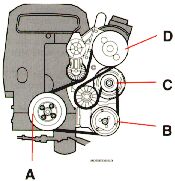
Belt check
Check the belt regularly to make sure it is in good condition and is clean. A worn or dirty belt can cause poor cooling and low generator output as well as impair the operation of the power steering and the air conditioning unit.
NOTE : The belt on the 850 is equipped with a self-tensioning mechanism and requires no adjustment between changes.
WARNING! The engine must not be running when this check is performed. |
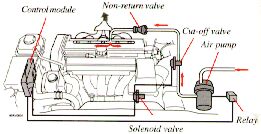
Air pump system (B5254S)
When the engine is being started from cold, an electrical air pump which draws air to the exhaust system is activated. This starts an afterburning process which leads to reduced hydrocarbon and carbon monoxide (HC and CO) emissions and reduces the warm-up period for the catalytic converter.
The pump starts when the car has been started and is moving. It continues to work until the catalytic converter has reached normal working temperature, although it can also start when the engine is idling. If the air pump is running and the engine is switched off, the pump continues working in order to protect the pump motor.
Note!
A soft whining noise can be heard from the pump, and when it performs a self-diagnosis, the high/low beam and the instrument lighting will flash briefly. This is completely normal.
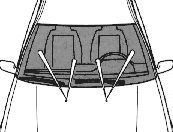
Adjusting washer nozzles
The washer jets should spray the windshield as shown above. Use the edge of a small screwdriver to adjust the nozzles if necessary.

Washer fluid reservoir
The washer fluid reservoir is located in the engine compartment and holds approx. 3.2 US qts. (3.0 liters).
During cold weather, the reservoir should be filled with windshield washer solvent containing anti-freeze.
Check coolant level
The cooling system must be filled with coolant and not leak to operate at maximum efficiency. Check the coolant level regularly. The level should be between the "MAX" and "MIN" marks on the expansion tank. The check should be made with particular thoroughness when the engine is new or when the cooling system has been drained.
Do not remove the filler cap other than for topping up with coolant. Frequent removal may prevent coolant circulation between the engine and the expansion tank during engine warm up and cooling.
Changing coolant
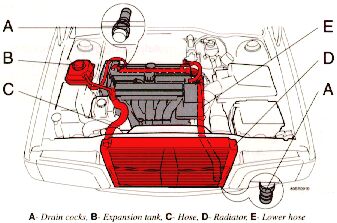
Normally, the coolant does not need to be changed. If the system must be drained, use the following procedure:
1
Remove the expansion tank cap.
2
Move the temperature adjustment control to max. heat. Open the drain cocks at the rear left of the engine block and at the bottom right corner of the radiator.
3
Disconnect the lower right radiator hose.
Filling:
4
Close the drain cocks and reconnect the hose.
5
Fill the expansion tank to the MAX mark or slightly above.
6
Run the engine until hot. Check the cooling system connections for tightness. Recheck the coolant level.
Capacity:
Approx. 7.6 US qts. (7.2 liters)
Turbo - 7.4 US qts. (7.0 liters)
Coolant: Volvo Genuine Coolant/Antifreeze only
NOTE: Do not top up with water only. Water by itself reduces the rust-protective and anti-freeze qualities of the coolant and has a lower boiling point. It can also cause damage to the cooling system if it should freeze.
WARNING: If the engine is warm and you are going to top up coolant, unscrew the cap slowly in order to allow any excess pressure to escape. |
CAUTION: The cooling system must always be kept filled to correct level. If it is not kept filled, there can be high local temperatures in the engine which could result in damage. Different types of anti-freeze/coolant may not be mixed. |
Engine compartment 850
(engine B 5254 S / B 5252 S)
1 Expansion tank, coolant
2 Engine designation plate
3 Oil filler cap, engine
4 Clutch/brake system fluid reservoir
5 Fuse box
6 Washer fluid reservoir
7 Power steering fluid reservoir
8 Dipstick - engine oil
9 Dipstick - automatic transmission
10 Air cleaner
11 Battery
12 Data plate
WARNING! The cooling fan may start or continue to operate (for up to 6 minutes) after the engine has been switched off. |
pg. 8:18 Engine compartment (cont.) |
Engine compartment 850 Turbo
(engine B 5234 T)
1 Expansion tank, coolant
2 Engine designation plate
3 Oil filler cap, engine
4 Clutch/brake system fluid reservoir
5 Fuse box
6 Washer fluid reservoir
7 Power steering fluid reservoir
8 Dipstick - engine oil
9 Dipstick - automatic transmission
10 Air cleaner
11 Battery
12 Data plate
WARNING! The cooling fan may start or continue to operate (for up to 6 minutes) after the engine has been switched off. |

