Replacing spark plugs
The spark plugs should be changed every 30,000 miles (48,000 km). However, city driving or fast highway driving may necessitate changing after 15,000 miles (24,000 km) of driving. When installing new plugs, be sure to fit the right type and use correct torque, see "Specifications". When changing the plugs, check that the suppressor connectors are in good condition. Cracked or damaged connectors should be replaced. When changing the spark plugs, clean the terminals and the rubber seals.
Hoisting the car
If a garage jack is used to lift the car, the two jack attachments points should be used. They are specially reinforced to bear the weight of the car. A garage jack can also be placed under the front of the engine support frame and under the reinforced plate in the spare wheel well. Take care not to damage the splash guard under the engine. Ensure that the jack is positioned so that the car cannot slide off it. Always use axle stands or similar structures.
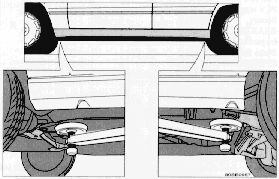
If a two-post hoist is used to lift the car, the front and rear lift arm pads should be centered under the reinforced lift plates on the inboard edge of the sill rail. The position of these plates is marked with arrows molded into the bottom of the sill rail.
CAUTION: 850 R turbo models have reduced ground clearance due to the design of the front spoiler. Please observe caution when driving the car onto a garage hoist. |
pg. 8:7 Servicing (cont.) |
Torque exhaust and intake manifold nuts
A loose manifold could alter air/fuel ratio and cause an increase in emission and/or poor driveability.
Air cleaner
Replace the air cleaner cartridge with a new one every 30,000 miles (48,000 km). The cartridge should be replaced more often when driving under dirty and dusty conditions. The filter cannot be cleaned and therefore should always be replaced with a new one.
Vacuum fittings, hoses and connections
Unstable idle, misfiring, or poor emission control is often caused by leaking vacuum hoses or connections. Check all vacuum hoses and connections.
Checking and adjusting idle air control system
Your Volvo is equipped with an electronically controlled idle air control system that requires no checking or adjustment.
Timing belt
For proper functioning of the vehicle and its emission control systems, Volvo recommends that the timing belt be replaced every 70,000 miles (112,000 km).
Fuel system cap, tank and lines and connections
The effectiveness of the fuel system to contain hydrocarbons is dependent largely on a leak-free system. Check for proper sealing of the gasoline filler cap which contains "O" ring type seals.
Fuel (line) filter
The fuel line filter is located next to the fuel pump. For proper functioning of the vehicle and its emission control systems, the fuel line filter should be replaced at 100,000 miles (160,000 km). The filter is replaced as one complete unit. Replace more frequently if contaminated fuel is introduced into the tank (or if there is reason to suspect that this has occurred).
Charge air cooler (Intercooler)
The B 5234 Turbo engine employs a turbo-compressor to force air into the engine inlet manifold and a charge air cooler to cool the compressed inlet air. The resulting increase in air flow raises pressure in the intake manifold by approx. 8.7 psi (over atmospheric pressure) and engine power output by approx. 50 horsepower over that developed by the normally-aspirated engine. The charge air cooler (which resembles a radiator) is located between the turbo-compressor and inlet manifold.
pg. 8:8 Servicing (cont.) |
Fuel System
The fuel system is all-electronic and is microprocessor-controlled. It can continually compensate for variation in engine load, speed and temperature to give the best economy and power. A mass air flow sensor measures the inducted air. In this way the system can make instantaneous adjustments for changes in air temperature or density, thus always assuring the best economy with the lowest possible exhaust emissions.
Heated oxygen sensor
This is an emission control system designed to reduce emissions and improve fuel economy. The heated oxygen sensor monitors the composition of the exhaust gases leaving the engine. The exhaust gas analysis is fed into an electronic module. This adjusts the air-fuel ratio to provide optimum conditions for combustion and efficient reduction of the three major pollutants (hydrocarbons, carbon monoxide and oxides of nitrogen (NOx) by a three-way catalytic converter.
Secondary Air Injection (certain models)
This system adds air to the hot exhaust gases as they are expelled from the engine. This causes a secondary combustion of residual hydrocarbons and carbon monoxide, resulting in lower emissions levels in the exhaust gases.
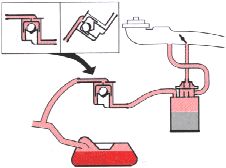
Evaporative control system
The car is equipped with a gas evaporative control system, which prevents gasoline fumes from being released into the atmosphere. The system is comprised of an expansion chamber in the fuel tank, a roll-over valve on the cross member in front of the fuel tank and a charcoal canister with a built-in vacuum valve under the left-front wheel housing. The components are interconnected by hoses which channel fuel vapor from the gas tank to the charcoal filter, where it is stored until the engine is started and then drawn into the engine's air intake system.
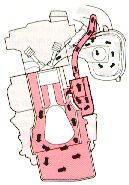
Crankcase ventilation
The engine is provided with positive crankcase ventilation which prevents crankcase gases from being released into the atmosphere. Instead, the crankcase gases are admitted to the intake manifold and cylinders.
PCV system
The orifice nipple in the intake manifold and the filter at the end of the PCV hose in the air cleaner should be inspected every 60,000 miles (96,000 km). Check/replace rubber hoses at the same time.
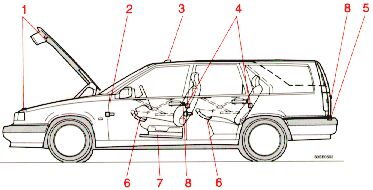
| No. | Lubrication point | lubricant | No. | Lubrication point | lubricant |
| 1 | Hood lock and latch | Oil | 6 | Window winder (on inside of door) | Oil, grease, low temperature grease |
| 2 | Door stop and hinges | Oil | 7 | Front seat slide rail and latch | Oil |
| 3 | Sun roof wind deflector |
Oil
Low temperature grease | 8 | Door locks | Volvo teflon lock spray |
| 4 | Door lock catch plate | Oil | |||
| 5 | Trunk/tailgate lid lock | Low temperature grease |
To avoid rattles and unnecessary wear, the body should be lubricated at regular service intervals. This should be done by an authorized Volvo retailer.
Checking the oil level
The oil level should be checked every time the car is refuelled. This is especially important during the engine break-in period (up to the first service).
CAUTION : Not checking the oil level regularly can result in serious engine damage if the oil becomes too low. |
Park the car on a level surface and wait for at least 3 minutes after the engine has been switched off. Be sure the oil level is maintained between the upper and lower marks on the dipstick. Low oil level can cause internal damage to the engine and over-filling can result in high oil consumption. The distance between the dipstick marks represents approx. 1 US qts (1 liter)*. The oil should preferably be checked when cold, before the engine has been started.
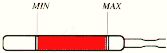
* Certain models: 1.6 US qts (1.5 liters)
NOTE: The engine must be stopped when checking the oil.
Draining the oil
Drain the oil after driving while it is still warm.
WARNING! The oil may be very hot. |
If you change the engine oil and filter yourself, your Volvo retailer can assist you in disposing of the used oil. Engine oil can be harmful to your skin - gloves should worn when performing this work.
To add or change oil
Add oil of the same kind as already used. Capacity (including filter): 5.6 US qts (5.3 liters) (certain models: 6.1 US qts/5.8 liters). Turbo models: 5.6 US qts (5.3 liters).** The oil filter should be replaced at every oil change
** Add 0.95 qts (0.9 liters) if the oil cooler has been drained.
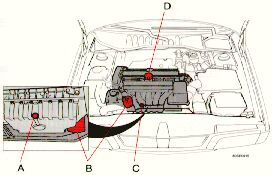
A - Drain plug, B - Oil filter, C - Oil dipstick, D - Oil filler cap
WARNING! Oil spilled on a hot exhaust pipe constitutes a fire risk. |
Oil quality
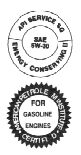
Meeting API specification SG, SG/CD, SH or Energy Conserving (EC) II
For best fuel economy and engine protection consult with your authorized Volvo retailer for recommended oils. Oils with a different quality rating may not provide adequate engine protection.
Viscosity (stable ambient temperatures):

Do not use oils with other viscosity ratings. The use of incorrect viscosity oil can shorten engine life.
Volvo recommends the use of energy-conserving oils. Look for the API label. Synthetic oils complying with oil quality requirements are recommended for: Driving in areas of sustained temperature extremes (hot or cold), when towing a trailer over long distances or for a prolonged driving in mountainous areas.
Extra oil additives must not be used unless advised by an authorized Volvo retailer.
SAE 15W/40 is recommended for use in driving conditions that raise oil temperature and increase oil consumption (i.e., mountain driving, trailer towing).
NOTE: SAE 15W-40 must not be used at low ambient temperatures; see viscosity chart.
Changing oil and oil filter
Oil and oil filter changes should be made as specified in the following table:
| If driving conditions include: | Then the correct oil/oil filter change interval is: |
|
|
EVERY
5,000 miles= 8,000 km OR EVERY 6 MONTHS, WHICHEVER COMES FIRST |
|
|
EVERY
10,000 miles = 16,000 km 5,000 miles= 8,000 km * OR EVERY 12 MONTHS, WHICH EVER COMES FIRST |
* Turbo models
|
American Petroleum Institute (API) labels. These labels certify the oil conforms to the applicable standards and specifications of the API. |
Power steering fluid
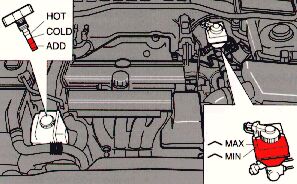
The dipstick has marks for checking hot and cold oil. The oil level when the engine is cold must never be higher than the
COLD
mark. After the engine has reached normal operating temperature, the level may not be higher than the
HOT
mark. Top up when the level is at the
ADD
mark.
Check the level at every service.
Fluid type: ATF
Replace: no fluid change required.
Brake and clutch systems
The brake and clutch systems share the same fluid reservoir. The fluid level should be between the MIN and MAX marks.
Fluid type: DOT 4+
Replace: Every second year or 30,000 miles (48,000 km). The fluid should be replaced once a year or every 15,000 miles (25,000 km) when driving under extremely hard conditions (mountain driving, etc.)
Check, without removing the cap, that the level is above the "
MIN
" mark of the fluid reservoir.
Always entrust brake/clutch fluid changing to an authorized Volvo retailer.
*At owner request

